Wood Hatch Autocad
Posted : admin On 20.12.2020- Stone Hatch Patterns Autocad Download
- Wood Hatch Autocad Download Free
- Wood Hatch Autocad 2020
- Autocad Free Hatch Library
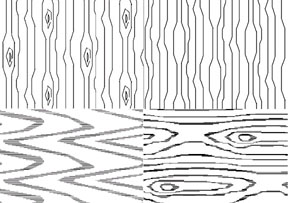
In AutoCAD, hatches are annotation objects — like text and dimensions — in that they don’t directly contribute to the geometry of what you’re drawing. However, they do impart additional information.
Like text and dimensions, hatches also need to be scaled to suit the final drawing scale. Start with the common ANSI31 pattern. As defined, it produces parallel lines spaced 1/8” apart. So far, so good — but what if you’re drawing the cross section of a large part, such as the 10’ boom on a backhoe?
AutoCAD dwg hatch, The file contains a selection of hatches not present in AutoCAD to be used quickly without importing the corresponding.pat files. Download Wood Hatch Autocad Fills an enclosed area or selected objects with a hatch pattern, solid fill, or gradient fill. When the ribbon is active, the Hatch Creation contextual tab is displayed. When the ribbon is off, the Hatch and Gradient dialog box is displayed.
Remember to always draw at full size and then scale when you plot. If you were to apply hatches at the nominal 1:1 scale and then plot at 1:10 to fit the boom on a smaller sheet of paper, the 1/8” hatch spacing becomes 0.0125 inch, which effectively becomes a solid fill. As with text and dimensions, you apply a scale factor of 10 to the hatches. The hatch lines in the drawing file then turn out to be 1.25 inches apart, which scale down to 1/8” when you plot.
Scaling the hard way
The hard way (the old way) to scale hatches is to calculate the scale factor before placing the hatches and then enter it into the appropriate window in the Properties panel on the Hatch tab of the Ribbon, in the hope that you don’t need to change the plotting scale later. You don’t even want to think about setting the scale for a detail at a different scale in the same drawing.
Scaling the easy way
The easy way to scale a hatch is to select the drawing scale from the Scale List button in the lower-right corner of the AutoCAD screen, the same as you do for text and dimensions, and then to turn on the Annotative option in the Options panel of the Hatch tab on the Ribbon. Now whenever you create hatches, they scale themselves correctly to suit the current plot scale.
The setting of the Annotative button is good for only the current editing session, and it must be reset if you add more hatches later. The AutoCAD Help facility states that this setting is saved in the drawing, but it isn’t.
It is strongly recommended that you turn off the Automatically Add Scales option when placing annotative text and dimensions, because you normally don’t want everything to show at every scale, especially when creating details at other scales. Hatches, on the other hand, normally do show in every view at every scale, scaled accordingly. You might be tempted to turn this option back on for hatches, but if you do, the first time you change the drawing scale, the new scale is added to all existing annotative objects. The best practice is to edit the hatches and manually add scales.
Don’t confuse annotative and associative, even though both are polysyllabic words that start with a and sit next to one another in the Options panel on the Hatch Creation tab. Annotative hatch objects scale themselves automatically to suit the drawing scale. Associative hatch objects (enabled by default) update to the new area when you change the hatch boundary.
Annotative versus non-annotative
Here are two versions of the same drawing, dressed up with annotative and non-annotative hatch patterns. As shown by the annotation scales displayed on the drawings’ status bars, the annotative hatches change their scales, whereas the non-annotative hatches remain unchanged.
There is another way: The hatches in both views are the same object, but because the viewports have different scales, the hatches adjust accordingly.
Before annotative hatches first appeared in AutoCAD 2008, the only way to create the effect in these two views in both drawings was to create two separate layers, one for each hatch scale, hatch the object twice, and then freeze and thaw layers as appropriate.
SUPERHATCH is a former AutoCAD Express Tool that is now included in the core AutoCAD product. You can create a hatch pattern from most anything without having to learn how to write a hatch pattern definition file.
This AutoCAD tutorial is by Autodesk’s own Cliff Young of the AutoCAD Test Development Team.
Stone Hatch Patterns Autocad Download
Step 1. Draw a rectangle and divide it into quadrants.
|
Step 3. Make 3 copies
|
Step 4. Trim the wood grain and copy the quadrants.
|
Step 5. Clean up the wood grain.
|
Step 6. Join all the polylines and convert to splines.
|
Step 7. Create a Block.
|
Step 8. Draw a boundary to be hatched with the wood grain.
Step 9. Using SUPERHATCH, apply the wood grain block to the boundary.
|
Step 10. Experiment.
|
Wood Hatch Autocad Download Free
Download Wood hatch other DWG
Wood Hatch Autocad 2020
Thanks Cliff!
If you have a tutorial on an Autodesk product they want to be posted to this blog and read by thousands of readers, please email me.
Cheers,
Shaan
adskbhsverall