Lan Speed Test Server Serial Key
Posted : admin On 17.12.2020One of the worst things to experience with your network is a sudden slowdown. Slow networks can be a disaster if you’re in the middle of an important business process, trying to impress a client, or rushing to complete an urgent task.
- MCS tests, measures & reports the performance and health of any network connection, LAN or WAN. MCS is an access everywhere web based enterprise solution. The MCS distributed satellite architecture delivers a powerful, low-cost, centrally managed, deployment model which is able to address the measurement requirements of global enterprise networks.
- This video will show you how to use iperf to test your local network (LAN) speed in Windows 10. You will need 2 computers on the same network, and the IP Add.
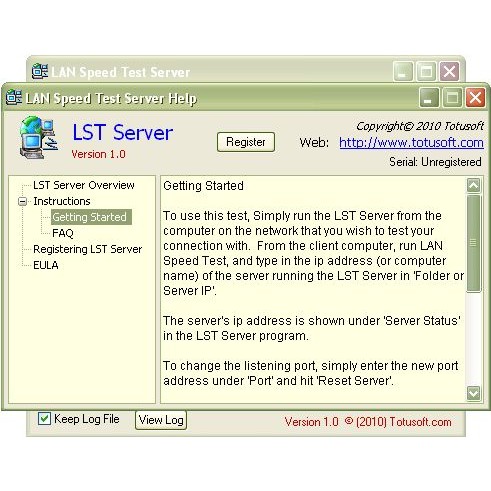
- This was the #1 feature request for LAN Speed Test. Using LAN Speed Test without the additional LST Server, writes the test file to another computer's hard drive. Network tests will be limited to drive speeds, caches, etc. This can be the performance test that you want to see as most of the time you are writing files to other hard drives (file.
High latency can become increasingly problematic as networks grow bigger, as having more connections means more points where delays and issues can occur. These risks become greater as your business connects to cloud servers, uses more applications, or expands to include remote workers and branch offices.
An internet speed test is an evaluation of your existing broadband parameters. Speed tests work by sending a file from your ISP server and analyzing the time it takes to download the file onto your local device (computer, tablet, smartphone, etc.) and then upload it back to the server. How to test speed of LAN using this LAN speed test software: Launch this software and enter the IP address along with the path of a test data of a PC over the same network in the Folders field. The whole path would look similar to this 192.168.1.123 User Test Folder. Port Checker is an online tool which checks a remote computer or device accessibility from the Internet. It can be used to check open ports or Ping a Port on a remote server. TCP Port Checker tries to establish connection from our server and if the connection is successful, you should be able to see it.
Girlvania crack. If you’re wondering how to improve latency, I highly recommend understanding and setting up processes for checking and reducing this problem across your network, so when a problem arises, you’re already equipped to handle it.
What is Network Latency?
Network latency is the time it takes for data or a request to go from the source to the destination. Latency in networks is measured in milliseconds. The closer your latency is to zero, the better.
The most common signs of high latency include:
- Your data takes a long time to send, as in an email with a large attachment
- Accessing servers or web-based applications is slow
- Websites do not load
Determining your network latency and improving it so network processes run faster is important for business efficacy, as well as simply making your workday less frustrating.
Best Practices for Monitoring and Improving Network Latency
Before you can improve your network latency, it’s important to first understand how to determine your latency and the different ways you can measure it. By knowing your latency, you can better troubleshoot any problems you’re having to ensure data travels more quickly.
How to Check Network Latency
The first thing you need to do if you think your network is going slowly is to check your current network latency. Using Windows, you can open a command prompt and type tracert followed by the destination you’d like to query, such as cloud.google.com.
How to Measure Network Latency
Once you type in the tracert command, you’ll see a list of all routers on the path to that website address, followed by a time measurement in milliseconds (ms).
Add up all the measurements, and the resulting quantity is the latency between your machine and the website in question. IT administrators or professionals will typically use network monitoring and management tools to get this information automatically.
Latency can either be measured as the Round Trip Time (RTT) or the Time to First Byte (TTFB):
- RTT is defined as the amount of time it takes a packet to get from the client to the server and back.
- TTFB is the amount of time it takes for the server to receive the first byte of data when the client sends a request.
How to Reduce Network Latency
When you are considering how to improve network latency, there are different steps you can take at various points across the network. First, make sure other people on your network aren’t using up all the bandwidth or increasing your latency with lots of downloads or streaming. Then, check application performance to ensure no applications are acting in unexpected ways and putting pressure on the network.
Subnetting can also help reduce latency across your network as you can group together endpoints that communicate most frequently with each other. Additionally, consider using traffic shaping and bandwidth allocation measures to improve latency for the business-critical parts of your network. Finally, you can use a load balancer to help offload traffic to parts of the network with the capacity to handle some additional activity.
How to Troubleshoot Network Latency Issues
If you want to make sure latency issues are on your network, you can try disconnecting computers or network devices and restarting all the hardware. Make sure you also have a network device monitor installed so you can check if any of the devices on your network are specifically causing issues. Be aware, even if you fix a bottleneck somewhere in your network, you might simply be creating another one somewhere else.
If you still have latency problems after thoroughly looking at all your local devices, it’s possible the issues are coming from the destination you’re trying to connect to. Troubleshooting issues across a large network becomes complex when you try to pinpoint an issue manually, and I generally recommend troubleshooting tools and software to help you with this task.
How to Test Network Latency
Testing network latency can be done by using ping, traceroute, or My TraceRoute (MTR) tool. More comprehensive network performance managers can test and check latency alongside their other features.
The importance of measuring and reducing latency cannot be overstated, as maintaining a high-performance and reliable network is a big part of having a successful business. If managed poorly network issues can become a substantial business risk, so using appropriate management protocols and tools is vital for any professional enterprise.
What Tools Help Improve Network Latency?
Five nights at anime free download for android. Using tools to improve network latency is familiar to most network professionals, and there are several different options with network latency measuring features.
A network performance monitoring tool is the most comprehensive kind of tool you can use, as it normally includes features let you address latency and network performance. A tool like SolarWinds® Network Performance Monitor (NPM) also provides functions like network latency testing, network mapping, problem troubleshooting, and general network baselining.
With network monitoring tools, you can typically set network baseline expectations for latency and then set up alerts when the network latency reaches a certain threshold above this baseline. You can also often set up data comparisons between different metrics, so you can see links between different performance issues, such as application performance or errors also affecting network latency. A network mapping tool can also help you pinpoint where within the network latency the performance issues are occurring, which allows you to troubleshoot problems more quickly.
You can also look at using a dedicated traceroute tool to look at packets and how they move across an IP network, including how many “hops” the packet took, the roundtrip time, best time (in milliseconds), as well as the IP addresses and countries the packet traveled through. This can help you pinpoint the places in the network with high latency and troubleshoot those issues if they’re a part of your network under your control.
While many tools include traceroute capabilities in their suite of features, consider whether you need a full performance monitoring tool or if a traceroute tool is enough for your needs. If you’re looking for a basic option, you could use a free traceroute tool like Traceroute NG to find latency and packet loss occurring on a network. It can also detect path changes and send alerts. For a more robust latency monitoring solution, SolarWinds NPM is designed to identify the source and nature of network and application latency, reliability, and other performance problems.
All these tools can help you measure network latency across the entire network or between points. By improving your network speed and reducing latency, your business processes will also make leaps and bounds towards efficiency and high performance.
Updated: January 10, 2020 Home » Freeware and Software Reviews » Wireless WiFi Optimization & Network
How to test internal LAN network speed? In order to test and troubleshoot networks we need tools that allow us to generate network traffic and analyze the network’s throughput performance. This is true for both wired and wireless networks. In order to properly troubleshoot a wireless (or wired) network we need a way to benchmark its performance, so as modifications are made we can determine whether or not they really make a difference in the network’s performance.
Alternative 2020 Article ➤ 4 Free P2P Intranet Software – Create Home Office File Sharing Network
This is where these LAN benchmarking tools fits in to test network speed between two computers. The concept is you install a new wireless network and it works perfectly. Run these tools and record the benchmark results for later reference. Sometime in the future when either you or others suspect performance has declined then run these tools again and compare the latest results with those you gathered when the network was first installed and working perfectly.
↓ 01 – LAN Speed Test Lite Windows macOS
LAN Speed Test was designed from the ground up to be a simple but powerful tool for measuring file transfer, hard drive, USB Drive, and Local Area Network (LAN) speeds (wired & wireless). First, you pick a folder to test to. This folder can be on a local drive or USB drive, etc. to test the drive speed, or a shared folder on your network to test your network speed.
Next, LAN Speed Test builds a file in memory, then transfers it both ways (without effects of Windows/Mac file caching) while keeping track of the time, and then does the calculations for you. For more advanced users, you can test to LAN Speed Test Server instead of a shared folder to take the slower hard drives out of the process as you are testing from one computer’s RAM to another computer’s RAM. Simple concept and easy to use. You’ll find that LAN Speed Test will quickly become one of your favorite network tools!
- Test the speed of your Local Network by testing to/from network shared folders
- Test the speed of your local drives (USB Drives, hard drives, etc.)
- Compatible with LST Server (v1.5 or later) for real network performance results without hard drive limitations – Even test your WAN (Internet) speed with LST Server
- Ability to choose Network Interface Card for computers with multiple NICs
↓ 02 – HELIOS LanTest Windows macOS
HELIOS LanTest is a very popular network performance and reliability testing solution for Mac and Windows clients. It is very easy to use within seconds and scales from single local disk testing, to testing performance of a network volume, as well as multi-user concurrent client testing against a single server volume.
HELIOS LanTest can be downloaded via HELIOS WebShare at Server: http://webshare.helios.de, User name and password are – tools
↓ 03 – TamoSoft Throughput Test Windows macOS
TamoSoft Throughput Test is a utility for testing the performance of a wireless or wired network. This utility continuously sends TCP and UDP data streams across your network and computes important metrics, such as upstream and downstream throughput values, packet loss, and round-trip time, and displays the results in both numeric and chart formats. TamoSoft Throughput Test supports both IPv4 and IPv6 connections and allows the user to evaluate network performance depending on the Quality of Service (QoS) settings.
Microsoft Windows: Windows 7, Windows 8, Windows 8.1, Windows 10, Windows Server 2008, Windows Server 2008 R2, Windows Server 2012, Windows Server 2012 R2. Mac OS X: Yosemite (10.10), El Capitan (10.11), Sierra (10.12), High Sierra (10.13), Mojave (10.14). Android (client only): Android 4.1 and newer. iOS (client only): iOS 8.0 and newer.
↓ 04 – LANBench Windows
LANBench is a simple LAN / TCP Network benchmark utility. It is designed for testing network performance between two computers and is based on Winsock 2.2. LANBench tests TCP performance only and is designed for minimal CPU usage so that the pure performance of your network could be fully tested.
- Multiple simultaneous connections – up to 20 (for load simulation)
- Low CPU overhead for pure network performance test
- Multithreaded utilizing Windows I/O completion port
- Configurable packet size, test duration and transfer mode
↓ 05 – NetIO-GUI Windows
NetIO-GUI is a Windows frontend for the multiplatform commandline utility ‘netio’. It measures ICMP respond times and network transfer rates for different packet sizes and protocols. All results are stored in a SQLite database file and can easily be compared. NetIO-GUI is preferred to rate the quality of peer-to-peer connections like VPN.

↓ 06 – NetStress Windows
NetStress allows you to generate network traffic and analyze the network’s throughput performance. The results of that comparison with previous benchmark will indicate whether or not there really is a problem and dictate which steps to take next (if any). Regardless of your technical expertise or how expensive your diagnostic tools, if you are modifying a wireless network or making decisions to modify it and you are not testing throughput then you risk wasting time and resources going down the wrong path.
- Single instance of the application (i.e. each instance can be used as server or server plus client)
- Supports both TCP and UDP data transfers
- Supports multiple data streams
- Variable TCP / UDP segment size
- Rate of packet transmission (Packets Per Second)
- Variable Maximum Transmission Unit (MTU)
- Uplink and downlink modes
- Auto node discovery
- Choice of display units (KBps, Kbps, MBps, Mbps)
- Support for multiple network adapters
↓ 07 – iperf macOS Linux
iperf is a tool for active measurements of the maximum achievable bandwidth on IP networks. It supports tuning of various parameters related to timing, protocols, and buffers. For each test it reports the bandwidth, loss, and other parameters. The current version, sometimes referred to as iperf3, is a redesign of an original version developed at NLANR/DAST.
iperf3 is a new implementation from scratch, with the goal of a smaller, simpler code base, and a library version of the functionality that can be used in other programs. iperf3 also a number of features found in other tools such as nuttcp and netperf, but were missing from the original iperf. These include, for example, a zero-copy mode and optional JSON output. Note that iperf3 is not backwards compatible with the original iperf.
↓ 08 – PassMark Advanced Network Test Free Trial Windows
The network benchmark test will work with any type of TCP/IP connection. Including ethernet, dial up modems, ADSL, cable modems, local area networks (LAN), Wide area networks (WAN) and wireless networking (WiFi). The software has been optimized to use a minimum amount of CPU time, allowing even high speed gigabit ethernet connections to be benchmarked. Users have the ability to change the following test parameters.
Lan Speed Test Server Serial Key 64-bit
- The IP address of the machine acting as the server and the port number used for the test to help with firewall issues.
- The size of the data block used for each send request. It is also possible to select variable sized blocks to measure performance deltas as block size increases or decreases.
- The duration of the test.
- The protocol, either TCP or UDP. The TCP protocol is when data integrity is important (Errors are corrected using data re-transmission). UDP is used with applications that are tolerant to data loss such as video streaming.